
Local SEO blog
Best CBD Keywords and SEO Keyword Research for Cannabis, Updated October 2026
September 4, 2026

How to describe CBD oil, which CBD terms matter, and how to find the best keywords for CBD oil
I have worked in cannabis and CBD SEO since 2020, and keyword research is one of the first places I see brands lose the plot.
Someone opens Ahrefs or Semrush, types in “CBD,” exports several thousand keywords, and calls the job done.
That spreadsheet may look impressive. It can also be completely useless.
CBD keyword research starts with the business model, the products, the buyer, the location, the page you need to build, and the claims your compliance team will approve. Search volume matters. So does intent. So does the ability to publish a useful page without creating a regulatory headache.
I use the same basic process for CBD brands, hemp companies, retailers, manufacturers, and product suppliers, and it works the same way for any cannabis business trying to earn organic traffic.
Start with the business model
A CBD brand selling tinctures online needs a different keyword plan from a local wellness shop selling CBD topicals in Grand Rapids. SEO for CBD businesses starts here, with the model, because the best keywords for one company are useless keywords for another.
The questions I answer first
Before I open a keyword tool, I answer a few basic questions:
- What does the business sell?
- Who buys it?
- Does the business sell online, in a store, wholesale, or through distributors?
- Which products have healthy margins?
- Which states can the business legally serve?
- Which claims can the brand support and approve?
- Does the site need product pages, category pages, local pages, educational content, or all four?
A CBD manufacturer may need terms connected to private label CBD, wholesale CBD products, bulk CBD oil, and CBD product formulation. Those are cannabis SEO keywords with low volume and real margins behind them.
A retailer may need CBD store, CBD gummies, CBD oil, CBD products near me, and local product availability. Keywords for CBD oil rank among the most competitive in the category, so a retailer usually wins faster with the local set first.
A pet-focused company may research CBD for dogs, dog CBD oil, and pet CBD products. Those topics need careful review because animal health claims create their own compliance concerns, and a CBD business owner who skips that review is betting the website on it.
The keyword list should reflect the business that exists. I do not build a keyword strategy around products a company does not sell just because the keyword looks popular. That discipline is what separates keyword research from keyword collecting.
Understand the difference between a query and a target keyword
A query is what someone types. A target keyword is the phrase you decide a specific page should win. CBD keyword research is the work of matching the first to the second, and every term on the list should end up assigned to a page or deleted.
Understand the search intent behind CBD keywords
Search intent tells me what the person wants to do next, and it matters more than raw search volume when a cannabis business has to choose where to spend its content budget.
I usually sort CBD keywords into these groups.
Informational keywords
The searcher wants an explanation. These are the longtail CBD keywords that fill an FAQ section and feed a CBD website’s educational cluster.
Examples include:
- What is CBD?
- What is broad spectrum CBD?
- What is full spectrum CBD?
- How is CBD oil made?
- CBD dosage questions
- How to use a CBD topical
These terms belong in educational guides, FAQs, glossaries, and product education sections.
Some informational keywords sit close to a purchase. Someone searching “full spectrum CBD vs broad spectrum CBD” may be choosing between two products. A clear comparison guide can answer the question and link to the relevant categories.
Commercial investigation keywords
The searcher is comparing products, brands, or features.
Examples include:
- Best CBD gummies
- Organic CBD oil
- Full spectrum CBD tincture
- THC-free CBD gummies
- CBD brand reviews
- CBD oil for beginners
What makes a good CBD keyword comes down to three things: intent that matches a page you can build, volume high enough to matter, and a claim your compliance reviewer will approve.
The word “best” creates a compliance review point. Product copy needs support for every meaningful claim, and comparisons need a clear method. A brand can discuss ingredients, serving size, extraction method, testing, format, flavor, and price without making unsupported treatment promises.
Transactional keywords
The searcher is ready to buy.
Examples include:
- Buy CBD oil online
- CBD gummies online
- CBD topical for sale
- Full spectrum CBD tincture
- CBD products with lab reports
- CBD wholesale supplier
These search terms usually map to category pages, product pages, collection pages, or wholesale landing pages.
A product page targeting “CBD gummies” needs actual gummies, useful product information, clear purchasing options, shipping details, testing information, and internal links to related products. A blog post cannot replace that experience.
Local keywords
The searcher wants a nearby business or a local product option.
Examples include:
- CBD store near me
- CBD shop Grand Rapids
- CBD products in Michigan
- CBD gummies near me
- CBD topical in [city]
- CBD delivery [city]
Local keywords can support Google Business Profile optimization, store pages, product availability pages, and location-specific content.
A local page needs real local value. Include the store address, hours, phone number, parking or access details, products carried, service area, and directions. A page with a city name swapped into the same paragraph fifty times gives visitors very little and can create a poor search experience. This is the part of CBD SEO that local SEO fundamentals handle well, and they apply here unchanged.
Product and ingredient keywords, or what CBD is called
These keywords describe what the buyer wants, and they double as the common CBD terms and other names for CBD that shoppers use, such as hemp extract, cannabis extract, cannabidiol, and full-spectrum or broad-spectrum oil.
Examples include:
- CBD oil
- CBD gummies
- CBD capsules
- CBD cream
- CBD balm
- CBD topical
- Broad spectrum CBD
- Full-spectrum CBD
- CBD isolate
- Hemp-derived CBD
- THC-free CBD
- Cannabidiol
- Hemp extract
- Cannabis extract
These terms often belong on category and product pages, and they are usually the most valuable keywords on the whole list because they describe exactly what the buyer wants. They can also create useful content clusters.
For example, a broad spectrum CBD category page could link to a guide explaining the difference between broad spectrum, full spectrum, and isolate products. That guide could link back to the products.
Problem-aware keywords, like CBD oil for back pain
People often search for a product while describing a concern or desired experience, which is where phrases like “which CBD oil is best for back pain” come from.
Examples may include searches connected to sleep, relaxation, stress, discomfort, or recovery. These are also the keywords most likely to create health and medical claim problems.
I treat these as a compliance review category before treating them as an SEO opportunity, because a page promising that a CBD product can treat a condition is a page a regulator can read.
The Food and Drug Administration says that only one prescription CBD product is approved, and the agency has warned companies about marketing CBD products with disease or treatment claims. The Federal Trade Commission has also said health claims require competent and reliable scientific evidence.
You can read the FDA’s CBD guidance and the FTC’s guidance on CBD health claims.
Search demand never gives a brand permission to publish an unsafe claim.
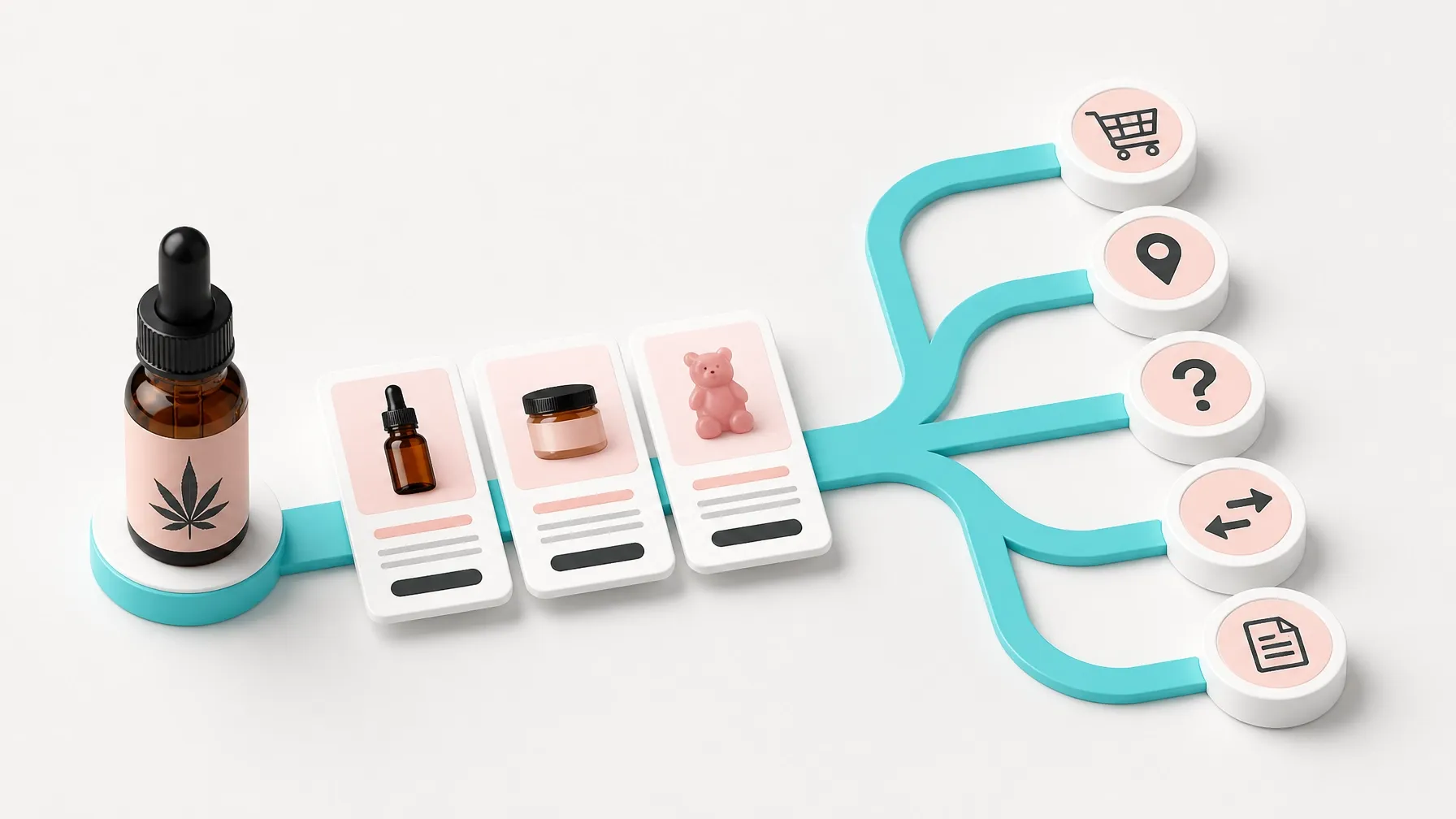
CBD oil keywords and how to group them
CBD oil is the term most brands chase first, and it hides the widest range of shoppers of any phrase in the category.
A person typing it may want a definition, a specific strength, a comparison, a store nearby, or a bottle delivered this week.
Treating it as one keyword means one page has to serve all of them.
I see keywords for CBD oil get flattened into a single row on a spreadsheet all the time, and the term actually splits into nine different jobs. Each job is really its own long-tail keyword with its own buyer.
The keyword groups hiding inside CBD oil
Format terms
Format terms describe the product type people think they want.
Examples include:
- CBD oil
- CBD tincture
- CBD drops
- CBD oil tincture
- sublingual CBD
People use oil and tincture interchangeably. The page needs to make clear which one the product actually is.
Spectrum and ingredient terms usually carry comparison intent
Examples include:
- full spectrum CBD oil
- broad spectrum CBD oil
- CBD isolate oil
- THC free CBD oil
- organic CBD oil
- hemp derived CBD oil
These often deserve their own page or guide section instead of a line inside a product description.
Strength and potency terms
Strength and potency terms usually come from buyers who already understand the product.
Examples include:
- 500 mg CBD oil
- 1000 mg CBD oil
- high potency CBD oil
- extra strength CBD oil
That makes them commercially valuable and easy to answer with a real specification.
Audience terms add another layer of intent and review
Examples include:
- CBD oil for beginners
- CBD oil for dogs
- CBD oil for seniors
Animal products and older buyers both add compliance review steps.
Experience and problem-aware terms describe the outcome someone hopes to get
Examples may include searches connected to sleep, stress, relaxation, discomfort, or recovery.
These belong in a compliance review before they belong on a keyword plan. The Food and Drug Administration says that only one prescription CBD product is approved, and the agency has warned companies about marketing CBD products with disease or treatment claims. The Federal Trade Commission has also said health claims require competent and reliable scientific evidence.
Comparison terms show up when a shopper is narrowing down options
Examples include:
- CBD oil vs tincture
- CBD oil vs capsules
- full spectrum vs broad spectrum CBD oil
Buying terms
Buying terms usually ask the quality question in commercial language, and they are the specific keywords that convert fastest.
Examples include:
- best CBD oil
- buy CBD oil online
- CBD oil with lab reports
- third party tested CBD oil
The lab report angle is the safer way to answer the quality question that “best” is really asking, because “CBD related to lab testing” earns trust while “CBD to treat” earns a warning letter.
Local terms belong to a different page type from national ecommerce terms
Examples include:
- CBD oil near me
- CBD oil in a named city
- CBD store near me
Wholesale and supplier terms
Wholesale and supplier terms belong to a B2B path, and they are some of the most professional CBD SEO terms you will find because the buyer is a business, not a browser.
Examples include:
- bulk CBD oil
- wholesale CBD oil
- private label CBD oil
- CBD oil supplier
These belong to a B2B page with different content from a retail product page. Niche formats follow the same rule: a CBD coffee reseller audience searches differently from a tincture buyer, and the top SEO keywords for each audience rarely overlap.
Match each CBD oil group to a page
The group decides the page type.
A CBD oil category page needs real products on it, real strengths, real formats, and a clear path to buy.
A comparison guide answers the spectrum and format questions and links to the matching categories.
A strength or potency question belongs on the product page as a specification.
A local search belongs on a store page with an address, hours, and directions.
Wholesale belongs on a supplier page with minimums, lead times, and a contact path.
Internal linking helps all of this make sense. A guide should link down to the category it explains and the category should link back up to the guide. Several pages chasing the same phrase split the site’s own authority.
I would start with the two or three CBD oil groups the business can actually serve today, build those pages properly, and add the rest once the catalog and the compliance review can support them. Growing CBD traffic that way is slower in month one and faster by month six.
The keyword list buyers actually type, with volumes
Most CBD keyword lists online are just volume dumps, and most of them have not been touched in years. I would rather show you the terms organized by the job they do, with monthly search volume and keyword difficulty beside each one, so you can decide which keywords for CBD oil deserve a page on your site before you write anything. The numbers below come from Semrush US data, pulled October 2026. When you check them in your own tool and see a different figure, trust your tool’s current data over any list, including this one.
Informational CBD keywords
The informational questions buyers ask before they trust a seller:
| Keyword | Monthly searches | Difficulty | What the buyer wants |
|---|---|---|---|
| what is cbd | 33,100 | 66 | A definition, usually their first search |
| does cbd show up on a drug test | 1,300 | 16 | Reassurance before a job screening |
| how long does cbd stay in your system | 3,600 | 14 | Same worry, different phrasing |
| is cbd addictive | 3,600 | 47 | Safety check |
| does cbd get you high | 1,600 | 61 | The most common misconception in the category |
Comparison and risk-check CBD keywords
The comparison and risk-check searches that sit right before a purchase:
| Keyword | Monthly searches | Difficulty | What the buyer wants |
|---|---|---|---|
| cbd vs thc | 18,100 | 71 | Understanding what they are buying |
| thc vs cbd | 14,800 | 61 | Same question, reversed order |
| cbd oil side effects | 720 | 81 | Risk check, needs careful claim handling |
| cbd for sleep | 5,400 | 52 | Problem-aware, needs compliance review before use |
| cbd for anxiety | 3,600 | 75 | Problem-aware, needs compliance review before use |
Local CBD keywords
The local searches that map straight to a store visit:
| Keyword | Monthly searches | Difficulty | What the buyer wants |
|---|---|---|---|
| cbd near me | 12,100 | 49 | A store, today |
| cbd store near me | 6,600 | 28 | Same, with more purchase intent |
| cbd oil near me | 2,400 | 42 | Product availability nearby |
| cbd gummies near me | 4,400 | 47 | A specific format, locally stocked |
| cbd flower near me | 3,600 | 50 | A product most shops do not carry, so a real differentiator |
Product and audience CBD keywords
The product and audience terms that deserve their own pages:
| Keyword | Monthly searches | Difficulty | What the buyer wants |
|---|---|---|---|
| cbd for dogs | 14,800 | 51 | Pet products, needs its own compliance review |
| cbd oil for dogs | 5,400 | 57 | Same buyer, deeper in research |
| cbd for cats | 5,400 | 21 | Same category, different animal |
| cbd oil for cats | 1,900 | 25 | Same buyer, deeper in research |
| cbd vape | 9,900 | 44 | A format with its own age-verification rules |
Two honest notes on this table. The pet terms carry real volume and real risk together, since animal health claims get their own regulatory attention. The problem-aware terms like sleep and anxiety carry even more risk, which is why the section after this one exists. None of these rows should tempt anyone toward CBD-related keywords that promise treatment outcomes.
If you sell online only, the local table still matters to you, because the buyers searching for CBD products nearby would buy online when the local result fails them. If you run a shop, the informational table is how you earn the trust that turns a walk-in into a repeat customer. Either way, the long-tail CBD keywords in these tables are where a smaller CBD website can actually win.
Use your own data before chasing new keywords
I start with Google Search Console when a site has existing organic visibility, because it shows keywords for the CBD pages a business already has.
What the Performance report shows
The Performance report shows queries that caused a site to appear in search results, along with clicks, impressions, click-through rate, and average position. Google explains the report in its Search Console documentation.
I look for:
- Queries with impressions and few clicks
- Pages ranking around positions 11 through 30
- Product terms bringing impressions to blog pages
- Local queries appearing for non-local pages
- Unexpected questions the site already answers, including CBD related queries the owner never planned for
- Queries that reveal a page and keyword mismatch
A CBD brand may discover that its educational article receives impressions for “full spectrum CBD oil,” while its category page barely appears. That points to an internal linking and page-targeting problem.
Google Analytics helps connect organic landing pages to engagement and conversions. I also look at product performance, contact form submissions, and sales data when the client can share it.
Customer questions are excellent keyword research.
I pull ideas from support emails, live chat, product reviews, phone calls, social comments, retail staff, and internal site search. Customers use language that keyword tools often miss. They may ask, “Which CBD oil has no THC?” or “Can I use this topical on my feet?” Those questions can become content ideas, FAQ entries, or product page improvements after compliance review.
Expand the list with keyword tools
After I understand the business and existing demand, I use Ahrefs and Semrush to expand the list. This is where SEO keywords you would never guess on your own start showing up.
What each tool adds
Ahrefs is where I check Keyword Difficulty and the pages already ranking. Semrush is where the intent labels live, and its Keyword Magic Tool groups related phrases fast.
In Ahrefs, I review search volume, Keyword Difficulty, traffic potential, related terms, questions, and the pages already ranking. Ahrefs explains keyword research through concepts such as search intent, traffic potential, business potential, and difficulty.
The volume tables in this post came from Semrush because its intent labels matched how I already group these terms. The two tools disagree on individual numbers often enough that the honest move is naming the source and checking your own.
In Semrush, I use the Keyword Magic Tool to review volume, keyword difficulty, intent, related phrases, and keyword groups. Semrush explains those features in its Keyword Magic Tool documentation.
Free sources worth the time
For long-tail research specifically, autocomplete and Keyword Magic filters do most of the work: filter by word count of three or more and by question intent, then keep only phrases a specific page could answer.
I also use:
- Google autocomplete, which surfaces real search terms in the order real people type them
- Related searches
- “People also ask” questions
- Competitor category and product pages
- Competitor content gaps
- Product catalogs
- Internal site search
- Customer reviews
- Search results from the target state or city
The numbers in these tools are estimates. Search volume and competition change with seasonality, product trends, platform changes, and consumer behavior. I check current data before making a publishing decision, and so should anyone choosing the best keywords to target for a CBD site, since CBD search engine optimization rewards fresh data and punishes stale lists.
Evaluate business value and compliance risk
I score every keyword opportunity using several factors, because a spreadsheet of keywords to target means nothing until each one earns its place:
- Search intent
- Product or service fit
- Business value
- Search volume
- Competition
- SERP features
- Compliance risk
- Page type required
Volume against intent
A keyword with modest volume and strong buying intent may deserve more attention than a broad term with a giant number beside it. This is how you find the right keywords instead of the loudest ones.
“CBD oil” might look like the obvious target. It also attracts a wide mix of searchers. Some want definitions. Some want products. Some want dosage information. Some want a local shop. The SERP can include retailers, brands, marketplaces, medical resources, news, and educational pages.
A more specific phrase such as “broad spectrum CBD oil” may tell me more about the shopper’s needs. “Buy broad spectrum CBD oil online” shows even stronger purchase intent. Terms closely related to CBD itself, like format and spectrum names, are usually one step behind buying language in the same research session.
Read the SERP before you commit
I inspect the current search results before assigning a keyword to a page. If product pages dominate, I build or improve a product page. If detailed guides dominate, I create an educational resource. If local map results dominate, I focus on local SEO. Branded keywords show up here too, and seeing which brands already own the page tells me how hard the fight will be.
The search results are the closest thing to a live brief.

Turn the keyword list into a site structure
Once I have the research, I map keywords to pages, and this is the step most CBD business owners skip.
A basic CBD site structure might look like this:
- Category pages for CBD oil, CBD gummies, CBD topicals, and pet products
- Product pages for individual products and flavors
- Educational guides for CBD basics, ingredients, product types, and dosage questions
- Comparison pages for full spectrum CBD versus broad spectrum CBD
- FAQ sections based on real customer questions
- Local pages for real stores, service areas, and product availability
- Wholesale pages for suppliers, manufacturers, and business buyers
Using CBD keywords across an SEO strategy, not just site structure
Internal links connect the pieces, and the keyword plan keeps earning after launch: refresh the tables when Semrush data shifts, feed customer questions into new FAQs, and revisit the SERP each quarter because intent drifts.
A guide about broad spectrum CBD can link to the broad spectrum category. A CBD gummies category can link to a guide about ingredients and serving information. A local store page can link to products available at that location.
Each page needs a clear job. Several pages targeting the same variation can split authority and confuse the site structure. I would rather build one genuinely useful page for a topic cluster than publish six thin pages that repeat the same paragraph, a pattern that hurts CBD sites more than most because their commercial pages already compete with national publishers.
Avoid these CBD keyword mistakes
Chasing only high-volume keywords
High volume can create visibility. It can also bring vague traffic from people who are still learning what CBD means. The CBD market is full of big numbers that never turn into orders.
Look for fit, intent, competition, and business value together, and remember that search volume alone has never paid anyone’s bills.
Publishing restricted medical claims
Keywords connected to conditions and treatment can create serious problems. A compliance review belongs in the editorial process before publication.
Copying competitor keywords blindly
A competitor may rank for a term because of its authority, product range, location, backlinks, or years of content history. Copying the phrase does not copy the reason it ranks, which is why copying another CBD website’s keyword list rarely works.
Study the intent and the page experience first.
Creating thin city pages
A city page needs real information for that location. Add useful local details, accurate business information, and content that reflects the actual service area.
Using one page for every variation
CBD oil, full spectrum CBD oil, broad spectrum CBD oil, and CBD oil for dogs may require different pages because the products and search intents differ.
The answer depends on the catalog, the audience, the SERP, and the compliance review.
Treating search volume as a promise
A keyword tool estimate is a planning input. It is not a traffic guarantee, sales forecast, or ranking promise. Every keyword search volume number on this page is an estimate from one tool on one day.
My repeatable CBD SEO keyword process
Here is the process I use:
- Learn the business model and product catalog.
- Define the buyer and target audience, and the locations they live in.
- List product, ingredient, audience, comparison, local, and question-based search terms.
- Pull existing queries from Google Search Console.
- Mine analytics, reviews, support emails, and internal site search.
- Expand the list in Ahrefs and Semrush, and note keyword difficulty as you go.
- Search the current SERP for intent and page format.
- Review search volume, competition, business value, SERP features, and compliance risk.
- Map keywords to categories, products, guides, FAQs, and local pages.
- Build internal links between educational and commercial pages.
- Monitor organic traffic and update the plan as demand changes.
Why organic carries the load for CBD SEO
Before the process list, the one rule worth repeating: most CBD keyword mistakes are planning mistakes, and they are cheaper to avoid on a spreadsheet than to fix on a live site. The sections above showed how, and the list below names the traps.
CBD brands face advertising restrictions, shifting platform policies, and claim-sensitive copy requirements. Search engine optimization gives them a way to earn visibility through useful pages that answer real questions, and the cannabis industry is one of the few places where that channel carries almost the whole discovery load.
That opportunity comes with responsibility.
I have worked around regulated products long enough to know that a ranking is never worth publishing a claim the business cannot support. Build the keyword plan around what customers need, what the company can sell, and what the brand can say responsibly.
That is how CBD keyword research turns into an actual search strategy instead of a very large spreadsheet nobody opens again. Find the right keywords for a real business, assign every one to a real page, and the spreadsheet starts earning its keep.