
I’ve been doing cannabis SEO every day since 2020. And have been in the industry every day since 2016. And before that, dabbled for a few years. So I have watched this industry navigate every kind of regulatory nonsense you can imagine.
Changing rules. Moving goalposts.
Compliance requirements that seem designed specifically to make your marketing impossible.
But this one still makes me want to throw my Dunkin’ iced coffee at a wall.
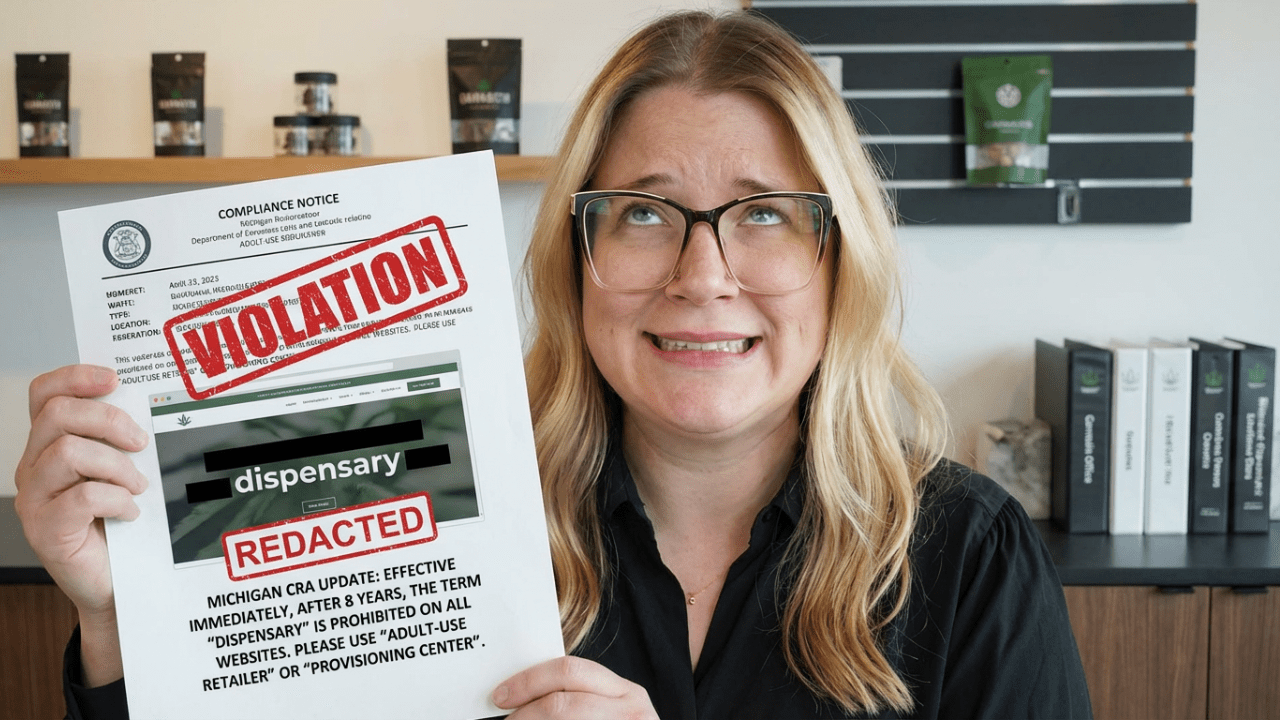
Michigan’s Cannabis Regulatory Agency prohibits cannabis retailers from using the word “dispensary” on their websites, in their advertising, on their signage, and in their business names.
Not because of cannabis law. Because of pharmacy law. The same statute that stops random people from calling themselves pharmacists.
Budtenders are not pharmacists. We all know this. And yet here we are.
Here’s why this matters specifically to your business. “Dispensary near me” gets 2.2 million monthly searches. That’s the term your customers type into Google when they want to find you. It’s the single highest-volume keyword in cannabis retail SEO. And in Michigan, you legally can’t use it.
Oh, and you can’t run Google Ads or Meta Ads to make up the difference. Because cannabis. So your only option is organic search, and the most powerful keyword in your category is off the table.
That’s the situation. Let’s talk about what to actually do about it.
Where This Rule Actually Comes From
This isn’t new. Back in June 2018, Michigan’s Department of Licensing and Regulatory Affairs issued an advisory bulletin laying out 16 terms that cannabis businesses can’t use. The list includes pharmacy, pharmacist, apothecary, drugstore, and yes, dispensary. The legal hook is Part 177 of the Michigan Public Health Code, which reserves pharmacy-related terminology for licensed pharmacy professionals.
Michigan law calls medical cannabis retail locations “provisioning centers.” Adult-use shops are “marihuana retailers.” The word “dispensary” doesn’t appear anywhere in the Michigan cannabis statute. Using it in your marketing puts your license at risk.
Michigan isn’t alone in this. British Columbia prohibits the same terms for cannabis retailers, including creative spellings. They even ban the green cross symbol. Connecticut’s statute flat-out makes it illegal for cannabis businesses to use “dispensary” in any advertisement or facility signage. These rules exist across multiple markets and are actively enforced.
The SEO Problem Is Bigger Than It Looks
Let me put some numbers on this so we’re all on the same page.
“Dispensary near me” gets 2.2 million monthly searches. “Dispensaries near me” adds another 368,000. “Dispensary” alone pulls 201,000. Stack up all the dispensary-containing keyword variations, and you’re looking at over 3 million monthly searches for a term you can’t legally target.
The closest legal alternative? “Cannabis store” gets about 20,000 searches a month. That’s roughly 1/80th the volume.

This is not a small gap. This is a canyon.
And unlike basically every other industry, you can’t compensate with paid ads. Cannabis advertising is prohibited on Google and Meta. That means organic SEO isn’t just important for cannabis businesses. It’s the only channel you’ve got. Losing your top keyword in organic search, with no paid option to fall back on, hits differently than it would in any other industry.
Here’s the other number that should get your attention: roughly 60% of cannabis consumers start their shopping journey with a search. And 76% of people who search for something nearby visit a business within 24 hours. Your customers are actively looking for you on Google right now. The question is whether they’re finding you or your competitor.
What You Can Say Instead (And What Actually Has Volume)
Here’s the keyword data from Ahrefs on the terms you’re actually allowed to use.
- cannabis store: 18,100 monthly searches
- weed shop: 9,900 monthly searches
- weed store: 9,900 monthly searches
- cannabis shop: 5,400 monthly searches
- marijuana store: 1,900 monthly searches
- marijuana shop: 1,600 monthly searches
- provisioning center: 390 monthly searches (Michigan-specific, use it)
- cannabis retailer: 320 monthly searches
None of these comes close to replacing the volume of “dispensary near me.” That’s just the reality. But they’re nothing, and they’re the keywords you can actually optimize for without putting your license on the line.
Stack them. Use “cannabis store” as your primary term. Layer in “weed shop” and “weed store” where appropriate. If you’re a Michigan medical retailer, lean into “provisioning center” for local searches. It has low volume overall, but your competitors aren’t optimizing for it either.
The Smart Move: Product-Based SEO
Here’s where cannabis SEO actually gets interesting. When your category keywords are restricted, you go deeper into product keywords. And product keywords have serious intent.
Strain names, brand names, and product categories all pull search volume from people who are ready to buy. Flowhub calls this the untapped gold mine of cannabis keywords, and they’re not wrong. Jeeter, Wana, Kiva, and other major brands each generate over 10,000 monthly searches. Someone searching for a specific brand or strain isn’t browsing. They know what they want, and they’re looking for where to get it.
Build dedicated pages for your top product categories. Optimize for the specific brands and strains you carry. Pair those with your city or neighborhood name. “Wana gummies Detroit” is a more specific, more winnable keyword than any broad category term, and the searcher has their wallet ready.
Your Google Business Profile Is Not Optional
Google’s own recommended primary category for cannabis retailers is already “Cannabis Store.” Not a dispensary. Google made this call before most regulators did.
Your Google Business Profile is the single highest-leverage SEO asset for a local cannabis business, and most cannabis retailers have a GBP that’s half-finished or badly optimized. Fill out every field. Write a keyword-rich description using the terms you’re allowed to target. Post regularly. Collect reviews. Keep your hours accurate.
The local pack, those three businesses that show up at the top of Google with the map, is powered primarily by your GBP. It’s the first thing your customers see. It needs to be locked in.
Don’t Just Delete and Swap. Rewrite with Strategy.
Here’s where I see cannabis businesses get this wrong. They get the compliance notice, they do a find-and-replace across their whole website, and they call it done. Dispensary becomes cannabis store everywhere it appears. Problem solved?
No. That’s not how it works.
Every page you update to remove the flagged term is a page you can optimize for something better. This is your opportunity to audit your on-page SEO, rewrite your page titles and meta descriptions, fix your headings, and actually build a keyword strategy that works within the rules.
Compliance without strategy means you’re doing the work and getting none of the benefit. Do it right the first time.
The Bottom Line
The CRA prohibition on “dispensary” is real; it’s been in effect since 2018, but they just started enforcing it now in 2026. The SEO impact is significant. But it’s not a death sentence for your rankings if you have a plan.
Use the keywords you can use. Go hard on product-based SEO. Lock down your Google Business Profile. And when you’re doing your compliance cleanup, treat every page update as an SEO opportunity.
Your customers are searching for you right now. Make sure they can actually find you.
Need help figuring out what your site needs after a compliance update? I do a free website review for cannabis businesses who are serious about their SEO. Let’s take a look at what you’re working with.