

Google Keyword Planner blocks cannabis terms. All of them. “Dispensary.” “Cannabis.” “Weed.” Type any of it in, and you get nothing back.
That’s the first thing I tell every new cannabis client, and it throws them every time.
Here’s the thing: the search demand is massive. “Dispensary near me” pulls over a million searches a month. Your customers are out there, actively searching. The problem is you’ve been handed broken tools to find them.
Let me break down exactly how I find cannabis SEO terms that drive real traffic. Not blog traffic. Traffic to your menu, your delivery page, your storefront.
Get your free Cannabis SEO Keyword List PDF
First, Understand Why Cannabis Keyword Research Is Different
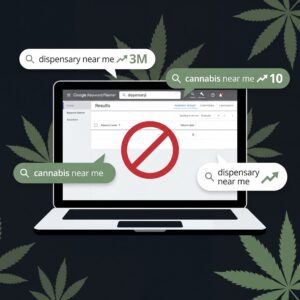
Here’s the thing. Google Keyword Planner returns blank results or zero volume data for almost every cannabis term. “Dispensary.” “Cannabis.” “Weed.” “Medical marijuana.” All blocked.
Why? Google classifies cannabis under its Dangerous Products and Services advertising policy. Keyword Planner exists to serve advertisers. Since cannabis ads are prohibited, Google has zero incentive to surface that data.
So your standard toolkit breaks immediately.
But here’s the reality: the search demand is massive. “Dispensary near me” alone pulls roughly 2.24 million monthly searches. That’s before you touch city-specific terms, product searches, delivery keywords, or strain names. There is no shortage of search demand. There’s just a shortage of SEOs who know how to find it.
The Tools I Actually Use for Cannabis Keyword Research
Google Search Console (Your Most Valuable Free Tool)
If your site already has traffic, GSC is the gold standard. It shows you the actual organic queries driving clicks to your pages, with no restrictions and no redacted data for cannabis terms.
I’ve found long-tail keywords in GSC that I never would have thought to target. Queries nobody puts in a research tool because they’re too specific. But real customers typed them, landed on a page, and clicked through.
GSC also gives you real click-through rate data that no third-party tool can match. That’s not an estimate. That’s your actual audience telling you what they searched.
Ahrefs and Semrush
Both show cannabis keyword data that Google Keyword Planner blocks. Semrush’s Keyword Magic Tool returns volume estimates and keyword difficulty scores for cannabis terms. Ahrefs’ Keywords Explorer and Content Gap analysis tools are useful for competitive research.
One honest caveat: because these tools rely in part on Google’s data, volume estimates for cannabis keywords may be less accurate than those for unrestricted industries. I always cross-reference both tools before committing to a keyword strategy. Don’t base your entire content plan on a single tool’s estimate.
Keyword Surfer
Free Chrome extension. Shows search volume directly in Google search results as you type. Useful for quick checks and building out lists without logging into a paid platform every single time.
Good Old Google (Seriously)
This one gets underestimated constantly.
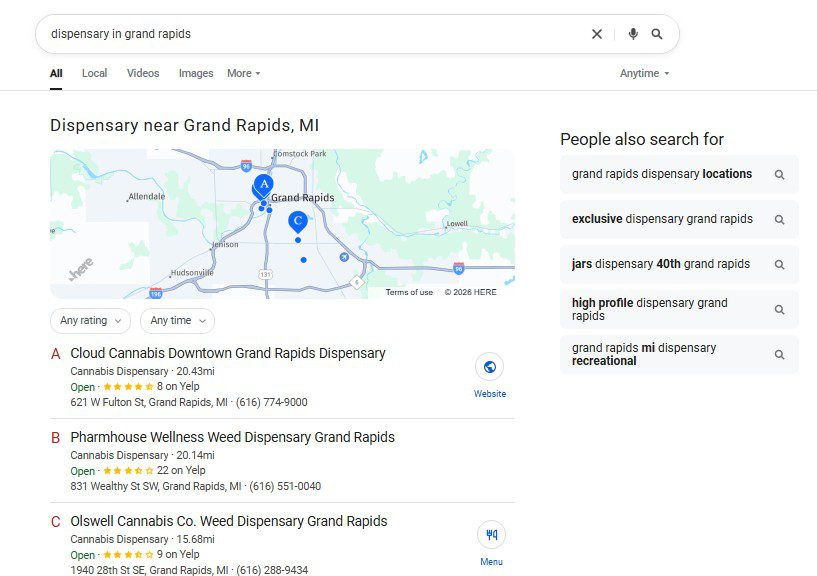
Google Autocomplete works in regular search even though Keyword Planner is blocked. Start typing “dispensary in [your city]” and watch what Google suggests. Those suggestions are based on real search behavior.
Google Maps autosuggest is another one I use. It surfaces local cannabis queries that reflect exactly how nearby customers search.
People Also Ask boxes appear for cannabis queries. Every question in that box is a keyword opportunity. Screenshot them, add them to your list, and build content around them.
Google Trends lets you compare terms and track relative interest over time. “Cannabis” is trending upward and moving toward surpassing “marijuana” in search volume. “Weed” still dominates raw volume. That matters when you’re deciding which terminology to use on a high-traffic page.
A Google Sheet
No joke. I keep a running keyword list in a Google Sheet. Every time I spot a new autocomplete suggestion, a PAA question, or a query in GSC I hadn’t tracked before, it goes in the sheet. Organized by intent: local, product, informational, and delivery.
Your keyword research isn’t a one-time project. It’s an ongoing process. The Sheet keeps it organized so nothing falls through the cracks.
The Keyword Categories That Actually Matter
Local Intent Keywords (Where the Money Is)
These are bottom-of-funnel. People searching for these are ready to visit or order today.
- “Dispensary near me”: 2.24 million monthly searches
- “Recreational dispensary near me”: 135K/month
- “Cannabis near me”: 60.5K/month
- “Weed near me”: 49.5K/month
- “Medical dispensary near me”: 40.5K/month
Add your city name to every one of these. “Detroit dispensary.” “Grand Rapids dispensary deals.” “Denver weed delivery.” That’s where you actually win locally.
76% of users who search for a nearby dispensary visit a business within 24 hours. These aren’t browsers. These are buyers.
Product Keywords (10 Million Monthly Searches)
Here’s what most dispensaries miss completely. Product-related cannabis searches exceed 10 million per month, which is more than location searches. Strain keywords alone carry enormous volume:
- Girl Scout Cookies strain: 49.5K/month
- Blue Dream strain: 40.5K/month
- Ice Cream Cake strain: 40.5K/month
- Wedding Cake strain: 40.5K/month
- Runtz strain: 33.1K/month
If your dispensary carries these strains and you don’t have a dedicated, optimized page for each one, you’re leaving that traffic on the table. Someone is getting it. Make sure it’s you.
Delivery Keywords (Underserved and Growing)
Cannabis delivery searches have their own competitive niche, and competition tends to be lower than “dispensary near me” variants. If you have a delivery license, this is a priority target.
- “Weed delivery”: 33K/month
- “Weed delivery near me”: 7.3K/month
- “Cannabis delivery”: 5.8K/month
- “Same-day weed delivery [city]”: growing fast
City-specific delivery terms are where I see the most opportunity for local operators right now. The big directories can’t beat you on local. Build those pages.
Informational Keywords (Top of Funnel, But Don’t Skip Them)
Cannabis consumers visit an average of 3-4 educational pages before making a purchase. That’s your opportunity to capture them early and build trust before they ever see a menu.
Think: “indica vs sativa effects,” “how long do edibles take to kick in,” “what’s the difference between THC and CBD,” dosing guides, strain reviews. These aren’t glamorous. But they build the kind of topical authority that makes your commercial pages rank better, too.
CBD vs. THC Keywords: Different Intent, Different Strategy
This matters more than most people realize.
CBD searchers are looking for wellness and health benefits without intoxication. Their queries focus on therapeutic applications: pain, anxiety, sleep, and inflammation. Quality modifiers like “organic,” “full-spectrum,” and “lab-tested” appear constantly. Searches for those CBD quality modifiers grew 67% year-over-year. CBD searchers want to research first, then buy. Your CBD content needs clinical depth, transparent sourcing, and documented lab results.
THC searchers are transactional and local. They want strain names, dispensary hours, current deals, delivery options, and “open now.” They’re checking your menu and planning a visit today. Your THC pages need product selection, real-time inventory, deals, and frictionless local discovery.
Same industry. Completely different buyer behavior. Your content strategy has to reflect that.
The SERP Reality Check: Who You’re Actually Competing Against
I’m not going to sugarcoat it. Weedmaps and Leafly have massive domain authority. They still dominate many traditional organic results. Leafly pulls roughly 5 million organic search visits monthly.
But here’s what’s changing. Weedmaps and Leafly lost a combined 9 million monthly organic visits (a 46% drop) over a two-year period. Meanwhile, the top five individual dispensary websites experienced over 100% growth in organic traffic during that same timeframe.
Traffic is moving from directories to dispensary sites. Google is rewarding localized, product-rich, well-optimized dispensary pages.
And in the Local Pack (the map results that dominate mobile)? Weedmaps and Leafly can’t touch you. The Local Pack only shows businesses with verified physical locations. That’s yours to own.
One critical technical note: if your menu is embedded via iFrame from Dutchie, Jane, or Weedmaps, Google cannot crawl your products. That content is invisible to search engines. Native, crawlable product pages with proper schema markup are how dispensaries are capturing the product-intent traffic the directories are losing.
What to Actually Do With Your Keywords Once You Have Them
Research without execution is just a spreadsheet.
Once you’ve built your keyword list, prioritize by intent. Revenue-driving pages first: your menu, your delivery page, your location pages, your most popular strain pages. Informational content supports those pages, but it’s not the priority.
Map one primary keyword per page. Don’t stuff five strain names onto one page, hoping to rank for all of them. Build a dedicated page for each target strain, each product category, and each city you serve.
Manually check your competitors in the SERPs. Type your target keywords into Google. Look at what’s ranking. Ask yourself: Is that page actually better than what I could build? Usually, the answer is no. It just got there first.
Keep your keyword list updated. Cannabis search behavior shifts constantly. “Dispensary deals today” searches grew 58% in a single year. THC beverage keywords barely existed two years ago. The Sheet I mentioned earlier isn’t a one-and-done task. It’s living documentation.
Get your Free Dispensary SEO Checklist Here
One More Thing About Compliance
Your state’s advertising regulations affect your keyword strategy more than most SEOs acknowledge.
Some states restrict colloquial terms like “weed” and “pot” in advertising content, even though those terms get 10x the search volume of the clinical alternatives. Some states restrict pricing language, potency claims, or product imagery. Arizona fines run $20,000 per violation. That’s not a typo.
Know your state’s rules before you optimize around high-volume slang. The risk-reward calculation varies by market. I always review state cannabis marketing guidelines before building keyword strategies for new clients.
Google also treats cannabis as YMYL content (Your Money or Your Life). That means Google applies extra scrutiny under its E-E-A-T framework. Author credentials, sourcing, compliance disclosures, license numbers: these aren’t just legal requirements. They’re ranking signals.
Start Here If You’re Overwhelmed
I know this is a lot. So here’s the short version.
- Install Keyword Surfer (free) and start watching what Google autocompletes when you type cannabis terms
- Set up Google Search Console if you haven’t already
- Build a Google Sheet and collect keywords organized by intent
- Run your top competitors through Semrush or Ahrefs to see what they rank for
- Identify your 10 highest-priority pages and map one primary keyword to each
That’s your starting point. Just five steps that give you clarity on where to focus first.
Cannabis paid ads are still a serious uphill battle. Organic search is where this industry competes. And I’ve spent four-plus years learning exactly how to win that fight.
I’ve been feeding the algorithm since 1996. It’s always evolving. The question is if your cannabis business is evolving with it.