

I’ve been doing cannabis SEO every day for over four years. And the brands that consistently outrank their competition aren’t the ones with the biggest budgets.
They’re the ones that went deep.
Topical authority is the concept nobody in the dispensary marketing world talks about enough. It’s not flashy. It doesn’t have a cool acronym (yet). But it is quietly one of the most powerful levers you have in an industry where paid ads are a minefield and organic search is everything.
Let me break down what it actually is and why your cannabis brand needs to care about it right now.
What Is Topical Authority and Why Does It Matter for Cannabis

Topical authority means Google sees your website as the go-to expert on a specific subject.
Not just a page that mentions a keyword. A whole site that consistently publishes deep, interconnected, expert-level content on a topic. Strain profiles. Terpene guides. Dosing FAQs. Compliance explainers. All linked together, all pointing to the same conclusion: this brand knows what it’s talking about.
When you build that, Google rewards you with rankings across the whole topic. Not just one page. The whole cluster.
Here’s why this matters even more in cannabis than in other industries. You can’t run Google Ads for most cannabis products. Meta is a nightmare. You’re not buying your way to the top. Organic search is the primary channel, which means topical authority isn’t a nice-to-have. It’s your competitive moat.
The brands that own their topic own their market.
Moving Beyond Keywords to Subject Mastery
I stopped optimizing cannabis content for keyword density years ago. It’s a losing game.

What actually moves the needle is building content that proves you understand the subject at every level.
- Comprehensive guides.
- Honest product breakdowns.
- FAQs that answer what people are actually searching.
- Content that connects concepts instead of just stuffing phrases.
Think about it from a user perspective. Someone lands on your dispensary blog looking for information about indica vs. sativa. If your post actually answers that question thoroughly, links to related terpenes content, and then connects to a product page, that user stays. They explore. They convert.
Google notices all of that. Time on page. Pages per session. Return visits. Those engagement signals are votes for your authority.
One well-researched pillar page with five supporting cluster posts will outperform fifty thin keyword-stuffed blog posts every single time. I’ve watched it happen with my own clients.
Semantic Search and What It Means for Your Cannabis Content
Here’s the thing about how Google works now. It’s not matching keywords. It’s understanding topics.
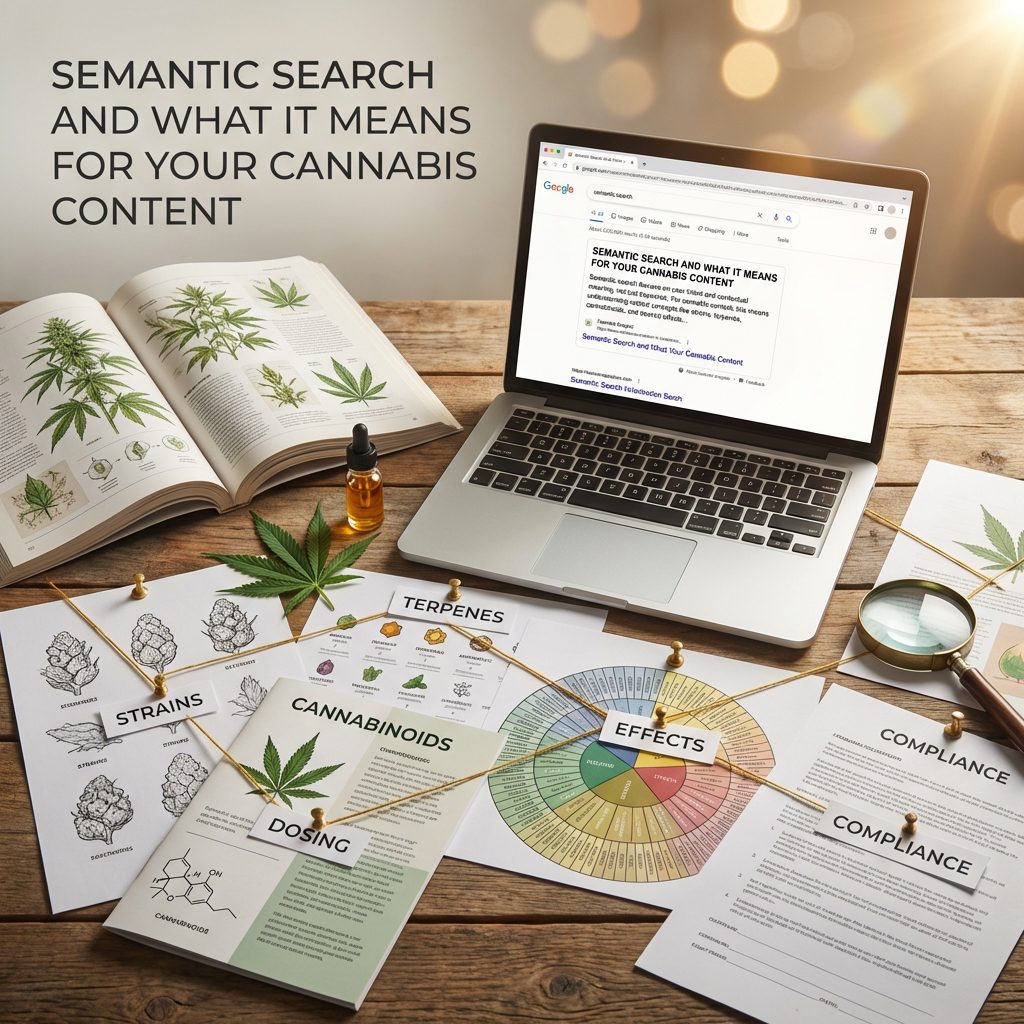
Semantic search means Google reads your content and maps the relationships between concepts. Strains. Terpenes. Cannabinoids. Dosing. Effects. Compliance. When your content covers those entities in context, with natural language and proper structure, Google understands what your site is actually about.
This is huge for cannabis brands because your topic is genuinely complex. There’s science involved. There’s legal nuance. There’s consumer education. That complexity is actually your advantage if you lean into it.
Practically speaking, this means tagging content with schema markup, building topic clusters around your core subjects, and answering the progressive questions a user has as they move from curious to ready-to-buy. Structure your content to show Google the relationships between ideas, not just the presence of keywords.
The brands doing this well are capturing rich results, featured snippets, and long-tail traffic that their competitors aren’t even aware they’re missing.
E-E-A-T, YMYL, and Why Cannabis Content Lives Under a Microscope
If you’ve spent any time in cannabis SEO, you’ve heard of E-E-A-T. Experience, Expertise, Authoritativeness, Trustworthiness. Google’s framework for evaluating content quality.

Cannabis falls into what Google calls YMYL territory. Your Money or Your Life. Content that could impact someone’s health, safety, or financial decisions. Google holds YMYL content to a higher standard, and it applies that scrutiny hard to cannabis.
I’m not going to sugarcoat it. This makes your job harder. Every health claim needs a source. Every dosing recommendation needs a disclaimer. Medical language without credentials is a fast track to getting buried in rankings.
But here’s the flip side. Most cannabis brands are ignoring this entirely. Which means doing it right is a real differentiator.
What E-E-A-T looks like in practice for cannabis brands: author bio pages with real credentials or real experience. Third-party lab results linked directly from product pages. Clear disclaimers on any health-adjacent content. Citations to peer-reviewed studies when you make claims about effects or benefits.
It’s more work. It’s also the work that builds a brand Google trusts long-term. And in a category where trust is everything, that matters.
Building Organic Resilience in a Restricted Industry
Algorithm updates hit cannabis brands hard. I’ve seen it. A core update rolls out, and dispensaries that were coasting on thin content suddenly disappear from page one.
Topical authority is your buffer against that.
When your site has genuine depth across a topic, one algorithm update doesn’t wipe you out. You have too many strong pages, too much internal link equity, too many signals of real expertise for Google to dismiss your whole site at once.
The brands that took the worst hit in every major update I’ve watched were the ones with a handful of optimized pages and nothing holding them together. No depth. No clusters. No authority signals.
Build the foundation right, and you stop chasing every algorithm change. You focus on serving your audience and let the authority compound over time.
How to Actually Measure If It’s Working
This is where a lot of cannabis marketers get lost. Topical authority isn’t a metric you can pull from a single dashboard. It’s a signal you measure across several data points over time.
Here’s what I track for my clients:
- Keyword breadth: Are you ranking for more topic-adjacent terms than you were 90 days ago? Topical authority expands your footprint across related queries, not just your target keywords.
- Share of voice: How often does your brand appear in search results relative to your local or category competitors? Tools like Semrush and Ahrefs can show this.
- Engagement signals: Time on page, pages per session, and scroll depth on your content cluster pages. Deep, attention-holding content is a strong authority signal.
- Conversion correlation: Are the users coming through your content cluster pages converting at a higher rate than general traffic? They should be. Intent-matched content converts.
Expect incremental gains in the first 1 to 3 months as technical improvements and new content are indexed. Real authority-driven ranking shifts typically show up between three and twelve months. This is a long game. The brands willing to play it are the ones still standing when competitors burn out chasing shortcuts.
Download my free Cannabis Dispensary SEO Checklist
Ready to build topical authority for your cannabis brand? Book a free call, and let’s map it out.
FAQ
What is topical authority, and how does it affect cannabis website visibility?
Topical authority means your site covers a cannabis subject so thoroughly and consistently that search engines treat you as the expert on it. You earn it through interconnected content clusters, detailed pillar pages, original research or real-world experience, clear author credentials, and quality backlinks from relevant sources. When you build it, Google rewards you with rankings across related queries and long-tail variations, not just your primary keywords. In cannabis specifically, you also need to source any health or medical claims to credible studies and stay current with local regulatory requirements.
How can a cannabis brand build topical authority, given advertising restrictions and competition?
Start with a content architecture that maps your core pillar topics and the supporting cluster pages around them. Think strain profiles, consumption methods, dosing, compliance, and local market content. Use real expert contributors, cite credible sources, and publish original data or client case studies when you can. Implement schema markup, maintain consistent internal linking, and update content regularly to ensure accuracy. Build topical backlinks by contributing to industry publications, partnering with research organizations, and creating genuinely useful resources people want to reference.
[…] establish yourself as a leader in the cannabis space, you must build what we call Topical Authority. This is the measure of how much Google trusts your site as an expert source on a specific subject. […]
[…] This is called topical authority. […]
[…] When I write for you, I am focusing on building topical authority for cannabis visibility. […]